 Analyzenn
Metocean Analysis
A rigorous characterisation of site conditions (wind, waves, current, water level) from measurements and reanalyses, to qualify an offshore site.
Understanding a site’s real conditions
Before you design, install or operate, you need to know the environment. Analyzenn builds metocean analyses that describe how wind, waves, current and water level behave at a given site, drawing on in-situ measurements, reanalyses and models, after careful quality control and harmonisation of the data.
Our scope
- Data quality control: outlier detection, gap filling, cross-checking measurements against reanalyses.
- Descriptive statistics: distributions, wind and wave roses, wind-sea correlations, seasonality.
- Normal and operational conditions: occurrences, persistence and windows, for planning and design alike.
What you get
A clean, documented dataset alongside reproducible analyses and visualisations. Every result is traceable back to its source data: a solid basis for your engineering studies, regulatory files or investment decisions.
Which projects is it for?
A metocean analysis is the first building block of most projects at sea:
- Offshore wind and marine renewable energy: qualifying the wind, wave or current resource, and site conditions for early-stage design.
- Offshore structures: design conditions for foundations, platforms and other structures at sea.
- Marine operations: weather-window and downtime statistics to plan and cost an installation or maintenance campaign.
Data and method
No single source is enough. We cross-check in-situ measurements (wave buoys, ADCP current meters), reanalyses such as ERA5 (long, homogeneous records) and wave models such as WAVEWATCH III. The bias of each source is quantified, then corrected against the available measurements, without inventing information where data is missing. The whole chain is scripted and replayable, so your teams can review and audit it.
For a detailed definition of the parameters and sources, see what metocean covers.
Frequently asked questions
What is the difference between metocean analysis and extreme value analysis?
Metocean analysis describes the usual conditions of a site: distributions, seasonality, persistence. Extreme value analysis instead estimates rare events (the 50-year storm, the 100-year wave) for design. Both rely on the same prepared dataset.
How much data is needed?
The longer and more homogeneous the record, the more robust the analysis. A measurement campaign rarely lasts more than one or two years: it is used to calibrate models, while reanalyses supply several decades for the statistics. Combining both is what makes the analysis defensible.
Why hire an independent metocean consultant?
An independent consultant is tied to no data or sensor supplier: sources and methods are chosen solely according to your need. You receive a documented line of reasoning, not a black box.
Do you work in French as well as English?
Yes. Analyzenn works in both languages, with deliverables aligned with your vocabulary and standards.
Going further
A site characterisation naturally feeds weather forecasting for executing operations and extreme value analysis for design. Have a project in mind? Get in touch.
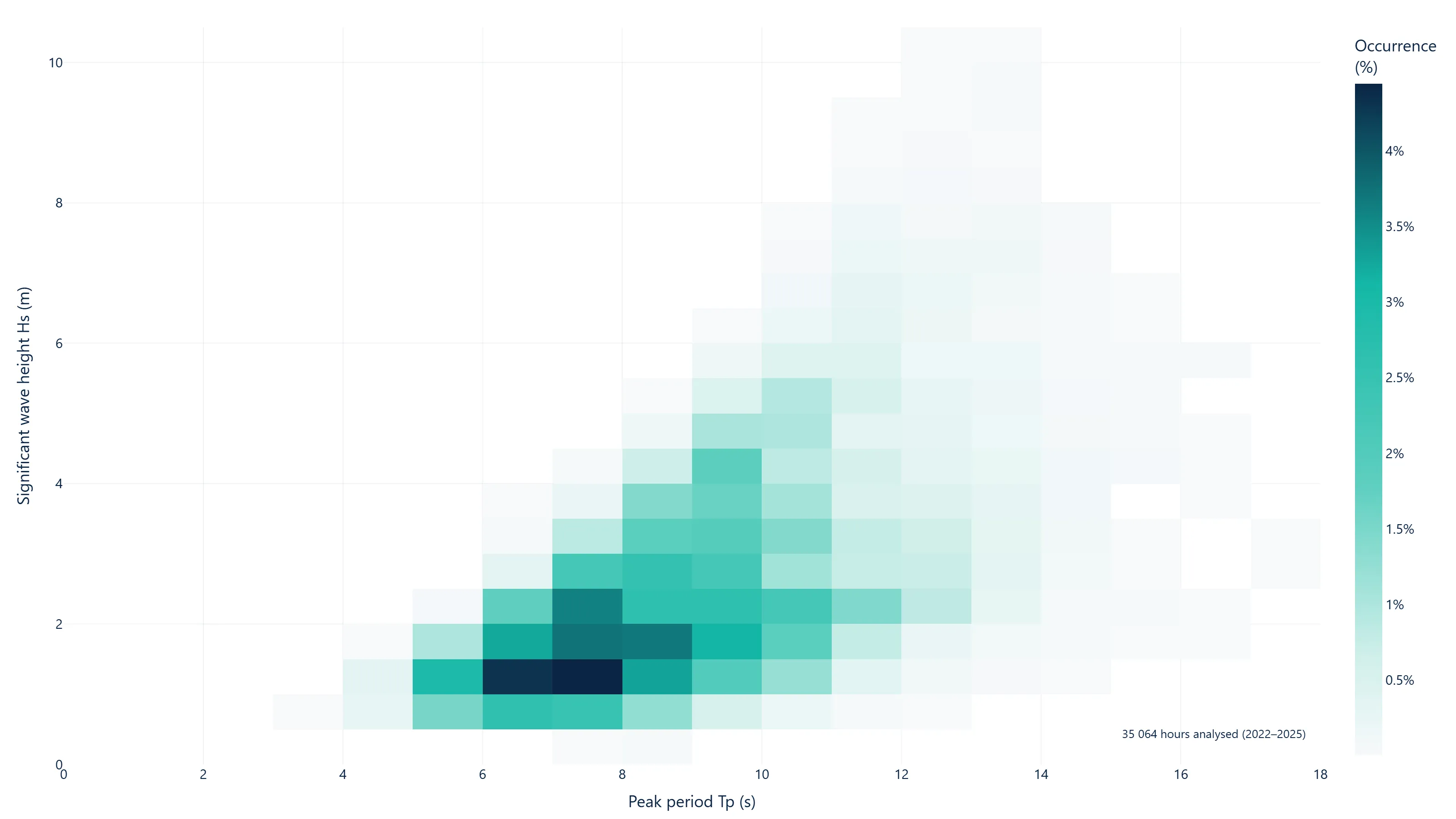
See this kind of result in practice: Hs/Tp scatter diagram — Iroise Sea →