 Analyzenn
Extreme Value Analysis
Statistical estimation of rare events (waves, wind, water level) and their return periods, to size offshore structures against robust, defensible design criteria.
Designing against rare events
An offshore structure is built to withstand what almost never happens. Extreme value analysis estimates the intensity of rare events, such as the 50-year storm or the 100-year wave, from records that, by their nature, contain few of them. This is the heart of the doctoral expertise Analyzenn draws on, applied to your design criteria.
Our scope
- Univariate extremes: distribution fitting (GEV, GPD), threshold selection, return periods and confidence intervals.
- Multivariate and conditional approaches: combinations of variables (wind-wave, wave-level) for realistic load cases.
- Uncertainty quantification: sensitivity to method choices and sample length, clearly documented.
What you get
Justified design criteria backed by a transparent methodological note on assumptions and uncertainties, enough to defend your choices before a certification body and your own teams alike.
Which projects is it for?
Any structure or operation whose design depends on a rare event: offshore wind foundations and support structures, platforms and other offshore structures. The resulting criteria (wind, waves, water level, and their combinations) feed directly into your design calculations.
Method
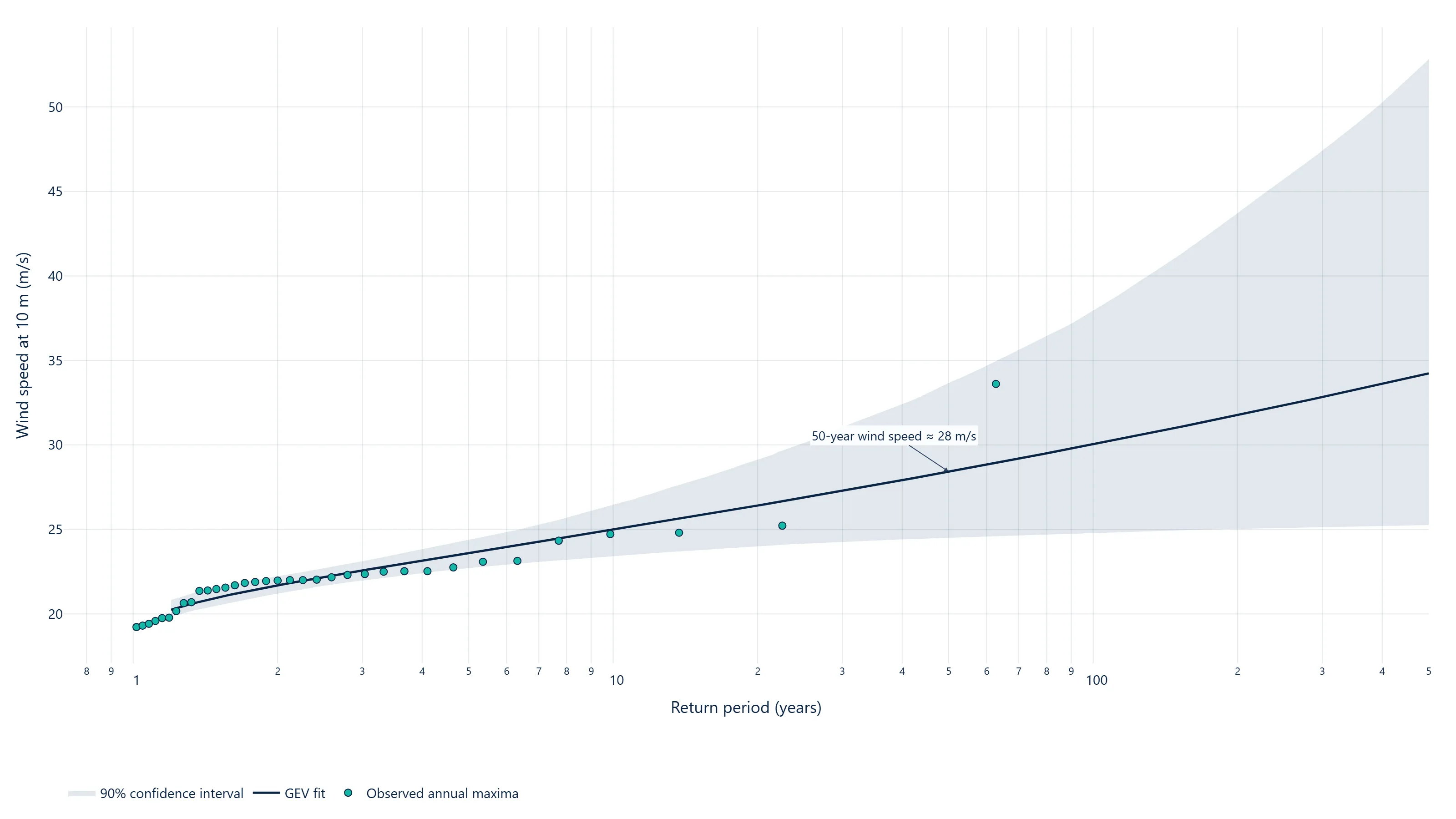
Two complementary approaches are used: fitting a GEV distribution to annual maxima, and the peaks-over-threshold method with a GPD distribution, which makes use of more data. Return periods come with confidence intervals (for example by bootstrap) and a sensitivity analysis to the choice of method and threshold. Reanalysis series, which smooth out peaks, are corrected against available measurements before any fit.
A complete example is presented in the analysis wind extremes from 35 years of reanalysis.
Frequently asked questions
What is a return period?
It is the average interval between two events reaching or exceeding a given intensity. A wave with a 50-year return period has a 2% probability, each year, of being reached or exceeded. It is not a prediction, but a statistical measure of risk.
How many years of data are needed?
The longer the record, the more reliable the estimate. Estimating a 100-year value from a few years of measurements is reckless extrapolation. Reanalyses, which span several decades, provide the necessary length, provided their bias on extremes is corrected.
Why is uncertainty part of the result?
Because a design criterion with no confidence interval or sensitivity analysis is not defensible before a certification body. We quantify and document it, so your design choices remain justified.
Can several variables be handled at once?
Yes. Realistic load cases often combine wind and waves, or waves and water level. Multivariate and conditional approaches avoid mechanically stacking extreme values that do not occur simultaneously.
Going further
Extreme values build on a prior metocean analysis of the site. For context, see what metocean covers. A structure to size? Get in touch.
See this kind of result in practice: Extreme wind values — 35 years of reanalysis →